
Fusarium Head Blight and the Risk of DON Mycotoxins

In durum wheat, Fusarium head blight is one of the most harmful fungal diseases. It does not only reduce yield, but can also contaminate the grain with mycotoxins, compromising its quality, marketability and safety. For farmers, buyers and processors, it is therefore an agronomic, economic and food safety issue.

Explore the content

What Fusarium head blight is and how it appears

Fusarium head blight in wheat is caused by a complex of fungal species, mainly Fusarium graminearum and Fusarium culmorum. Infection develops between heading and ripening, especially during flowering, when exposed anthers provide the ideal entry point for the fungus.

The most visible symptoms include

Discoloured ears

Early drying of spikelets

Pale pink mycelium in severe infections

Shrivelled and wrinkled kernels

Reduction in hectolitre weight and thousand-kernel weight

The real risk: deoxynivalenol, or DON

The Fusarium species that attack wheat ears can produce deoxynivalenol, known as DON. This mycotoxin belongs to the trichothecene group, a class of toxic compounds with strong cytotoxic and immunosuppressive properties.

The main problem is that DON is extremely stable. It does not break down during storage, milling, processing or even cooking. This means that once the grain is contaminated, the contamination remains throughout the entire supply chain, all the way to the finished food product.

Legal limits and marketability

European regulations set strict maximum limits for DON in cereals and cereal-based products. If these thresholds are exceeded, the product cannot be placed on the market, resulting in immediate economic losses for growers and potential responsibility for buyers and processors who purchase grain without adequate controls.

  • Loss of production: up to 50%
  • EU limit for marketing and for grain: 1,000 μg/kg of DON in finished products intended for human consumption

Conditions that favour Fusarium and DON development

Three environmental factors and three agronomic factors determine the level of risk in each field and in each season.

Environmental factors

rain icon

Rain during flowering

The infection window coincides precisely with flowering: rainfall and high humidity during this stage favour spore dispersal and the colonisation of exposed anthers.

temperature icon

Moderate temperatures

The optimal range for Fusarium graminearum is between 20 and 30 °C, which means that warm and humid springs can create highly favourable conditions for infection.
soil moisture

High relative humidity

High humidity supports fungal sporulation and keeps the ears wet for longer, extending the period in which infection can occur even beyond individual rainfall events.
Agronomic factors are just as important

Sowing wheat after maize or sorghum

Crop residues act as the main substrate where the fungus survives and reproduces. For this reason, crop rotation is one of the most effective preventive tools.

Minimum tillage and no-till systems

Conservation techniques that leave residues on the surface increase the availability of inoculum.
This is a major risk factor, particularly in tight crop rotations.

Varieties susceptible to Fusarium

Not all wheat varieties respond to Fusarium in the same way. Choosing more tolerant varieties, both under development and already available on the market, can significantly help reduce the problem.

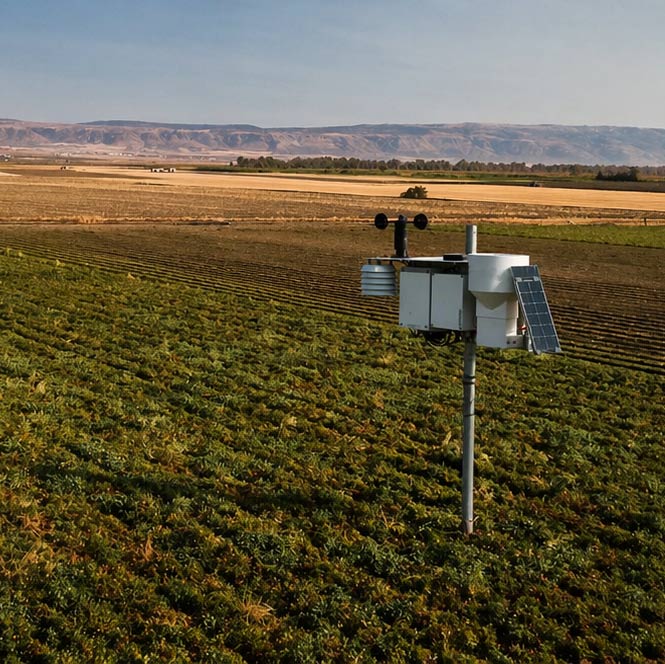
DSS weather station for agriculture

The treatment window: three days that can determine an entire season

For the fungicide treatment against Fusarium to be effective, it must be applied within a 3–4-day window, between the start of flowering and the point at which 30 per cent of the anthers have emerged.

To identify the optimal time for intervention, it is essential to constantly monitor the crop’s phenology and to use DSS systems integrated with agrometeorological stations to predict periods of risk and support precise and timely agronomic decisions.

Prevention strategies: protection begins before the fungus appears

Chemical control is important, but it is not enough on its own. Control of Fusarium head blight and DON is achieved through an integrated system of preventive measures:

Crop rotation

Avoid sowing wheat after maize, sorghum or other cereals. Legumes are the ideal rotation crop for breaking the fungal cycle and reducing the inoculum in the soil.

Soil tillage

Ploughing buries crop residues and drastically reduces the availability of spores on the surface.

Variety selection

Over the last 15 years, research has developed genotypes with greater tolerance to Fusarium head blight, while still maintaining the agronomic and supply-chain characteristics required (productivity, protein quality and rusticity). Varietal selection is the most sustainable preventive measure, particularly in the context of climate change.

Managing Fusarium risk with APOD’s technical support

Agrometeorological stations, DSS models, variety consulting and field monitoring: OP Apod members have access to the tools they need to identify the correct treatment window and protect the quality of the grain they deliver.

Frequently asked questions about Fusarium head blight in wheat

What is Fusarium head blight in wheat?

Fusarium head blight in wheat is a fungal disease mainly caused by Fusarium graminearum and Fusarium culmorum, which affects wheat during the flowering stage. In addition to reducing yield, it can compromise grain quality.

Because it does not only cause yield losses: it can also contaminate the grain with mycotoxins, particularly deoxynivalenol (DON), making the product unsuitable for sale.

DON (deoxynivalenol) is a mycotoxin produced by certain Fusarium species. It is toxic to humans and animals and may have cytotoxic and immunosuppressive effects.
No. DON is extremely stable: it is not eliminated during storage, milling or food processing.
The critical timing is a very short window of around 3–4 days, between the beginning of flowering and 30% anther emergence. Phenological monitoring is essential to intervene correctly.
Because crop residues from maize, sorghum and cereals host the fungus, allowing it to survive in the soil and increase the inoculum pressure on the following crop.

You may also like…

SPRING Certification: what it is, how it works, and why it matters for sustainable agriculture

On the occasion of the World Day to Combat Desertification and Drought, discover how APOD protects water resources through SPRING certification.